How to Analyze NPS Data: A Practical Guide for CX Teams
If you've run NPS surveys for any length of time, you've probably noticed something uncomfortable. The score itself rarely tells you what to do. You see a number, you see it move a few points, you build a chart, and then you're standing in front of leadership trying to explain what changed and why.
I've spent over a decade running and consulting on Voice of Customer programs. I've watched teams treat NPS as a magic number, as a vanity metric, as a renewal indicator, as an executive scorecard, and occasionally, when it was done well, as a real signal that drove operational change. The difference between "NPS as wallpaper" and "NPS as a tool that changes how your company operates" isn't the survey itself. It's how you analyze what comes back.
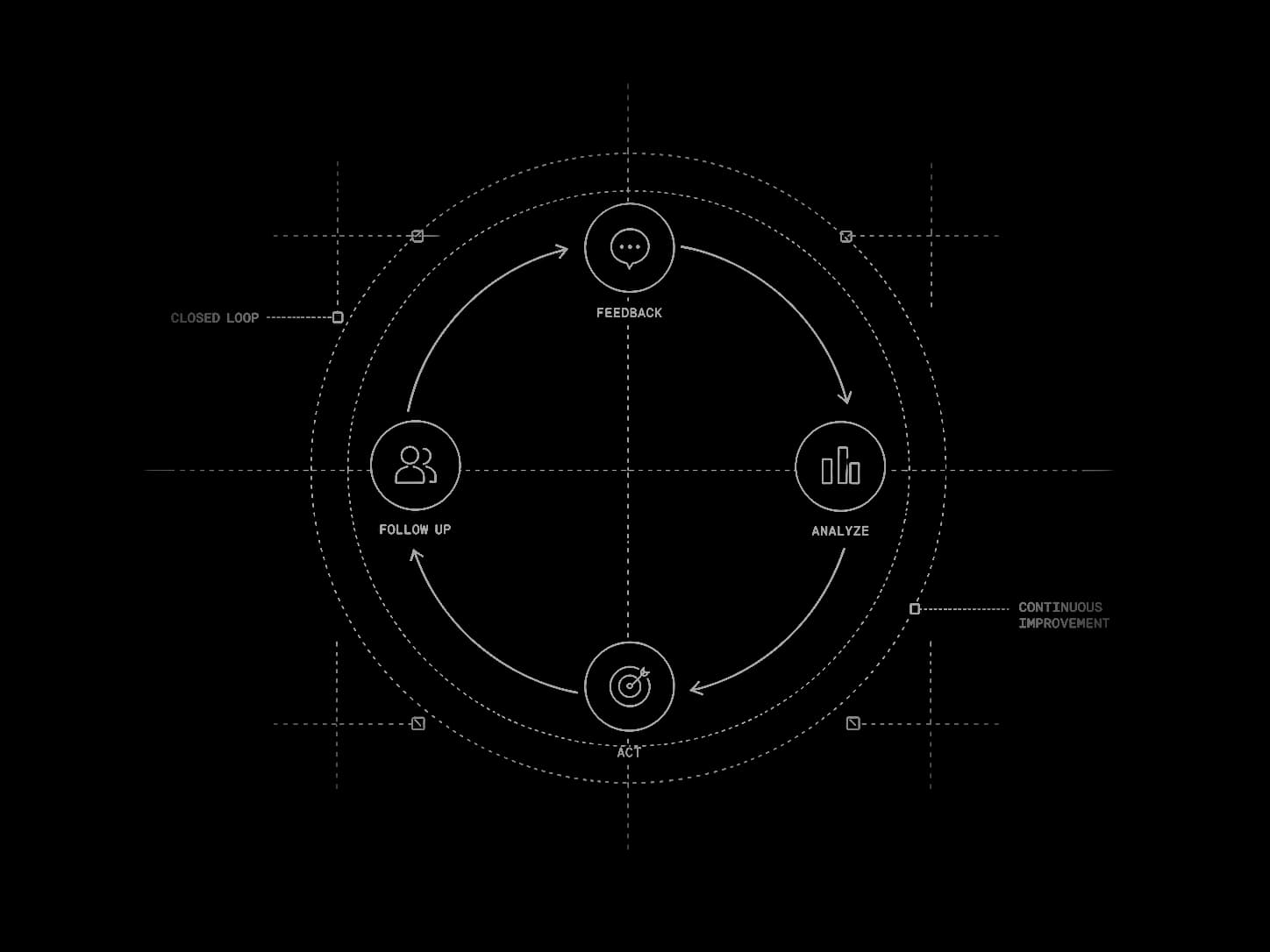
This guide is the version of NPS analysis I wish someone had handed me ten years ago. It assumes you can already calculate the score (it's basic arithmetic) and skips straight to the part most resources gloss over: how to turn the data into action that closes the loop, instead of into a dashboard nobody opens.
One honest disclaimer before we start.
NPS isn't actually that good a metric. Here's how to make it useful anyway.
It's worth saying out loud. NPS is more limited than its evangelists let on, and the academic literature has been increasingly skeptical of it for over a decade.
In a 2011 Harvard Business Review article and the follow-up book The Wallet Allocation Rule (Wiley, 2015), Timothy Keiningham and colleagues found that customer satisfaction and NPS "have almost no correlation to share of wallet." In other words, changes in your NPS don't predict whether customers will spend more or less with you. Their research concluded that satisfaction "typically explains a miniscule 1 percent of customers' share of spending in an industry category."
More recently, a 2024 paper by John G. Dawes in the International Journal of Market Research catalogues persistent methodological issues with NPS. A 2022 study in the Journal of the Academy of Marketing Science examining U.S. sportswear brands over five years found that the original NPS framing largely fails to predict sales growth, with only the "brand health" variant of NPS (which surveys non-customers as well) showing predictive value.
So why do we still measure it?
Because it's simple, it's comparable across industries, and when paired with the right analysis it points at the right questions. NPS doesn't tell you what's wrong. It tells you to go look. The score itself is almost beside the point. The value lives in the analysis you do because of the score: the segmentation, the driver work, the verbatim review, the closed loop.
This guide is about that analysis. If you take one thing away, it's this. Stop treating NPS as the answer. Start treating it as the prompt for everything else you should be doing.
The four layers of NPS analysis (do all four, in order)
Most NPS analysis stops at one or two of these. The teams that get real operational value from the metric do all four.
- Score-level analysis. What's the number, how is it moving, and is the movement statistically real?
- Segment analysis. Which slices of your customer base are driving the number?
- Driver and root cause analysis. Why are the segments scoring the way they're scoring?
- Closed-loop analysis. What happened after you acted on the data?
Layer 1 is the easy part, and most teams stop there. The other three are where the work, and the value, actually live.
Layer 1: Score-level analysis (the basics, done right)
Calculate the score correctly
The math is simple. NPS = % Promoters (9-10) minus % Detractors (0-6). Passives (7-8) don't count toward the score, but they're not invisible. More on that below.
What people get wrong here isn't the formula. It's the sample size and methodology. A few rules.
- Sample size matters less than response rate. A score of +50 from 8% of your customers is weaker evidence than +35 from 45%. Below a 15% response rate, you're getting detractor bias. Angry customers respond at higher rates than satisfied ones, which drags your reported score below your true score.
- Don't compare scores collected on different scales. A 1-5 satisfaction survey converted to an NPS-equivalent isn't comparable to a real 0-10 NPS. Post-transaction scores aren't comparable to quarterly relational scores. If you're cross-referencing, document the methodology.
- Year-over-year beats quarter-over-quarter for most B2B contexts. Seasonality and survey cadence variations can make QoQ noise dominate signal.
Look at the distribution, not just the score
The score collapses three numbers into one. That's its strength (simple comparison) and its weakness (lossy). Always look at the underlying distribution.
| Bad pattern | Better pattern | |
|---|---|---|
| Detractor cluster | Heavily at 0-2 (entrenched) | Concentrated at 5-6 (recoverable) |
| Promoter spread | All at exactly 9 (lukewarm) | Real spread to 10s (true advocates) |
| Passive distribution | Heavy at 7 (about to detract) | Lifting toward 8 (about to promote) |
A team with NPS +30 where detractors cluster at 5-6 has a different operational problem than a team with NPS +30 where detractors cluster at 0-2. The first is recoverable through follow-up. The second probably has a structural issue (pricing, product fit, competitive pressure) that no amount of detractor outreach will fix.
Benchmark against the right peers
Industry benchmarks are useful, but most CX teams use them wrong. They cite a single industry average and compare themselves to it. The number that actually matters is your peer cohort: companies with comparable size, business model, and survey methodology.
Recent industry medians, drawn from Retently's 2026 NPS Benchmark Report and Lorikeet's 2026 industry benchmarks:
- B2B SaaS: median ~30-36, top quartile 45+, world-class 60+
- B2C SaaS / consumer software: median ~47, top quartile 55+
- Financial Services: median ~35-45, varies heavily by sub-segment
- Retail: median ~40-50, top quartile 55+
- Healthcare: median ~30-40, with B2C healthcare scoring much higher than B2B
- Insurance: wide variance, median ~30-46
Notice the spread. A SaaS company with NPS +40 is in the top tier. A retail company with the same +40 is below average. Industry context determines what "good" means.
A more honest benchmark: pick 3-5 named competitors with your revenue model, your acquisition channel, and your relationship cadence. Compare to them. "B2B SaaS" isn't a peer set. "Mid-market B2B SaaS in regulated industries with quarterly relational surveys" is.
Layer 2: Segment analysis (where the real signal lives)
The aggregate score is a summary statistic. The interesting analysis happens when you break it apart.
The segments worth always looking at
Some segmentation cuts are universal. Run NPS analysis across all of these by default.
- By customer tenure. Are long-term customers more or less likely to be promoters? If tenure correlates negatively with NPS (longer customers means lower scores), you have a fundamental experience-decay problem. The cumulative effect of small frustrations is eroding the relationship.
- By revenue or customer size. Especially for B2B. A handful of high-revenue accounts scoring as detractors can be a much bigger churn risk than a hundred low-revenue accounts feeling the same way.
- By channel or touchpoint. Phone vs. self-serve vs. in-person. The score for one channel is often hiding behind the aggregate.
- By geography or region. Often surfaces operational issues with specific local teams, vendors, or compliance environments.
- By plan or tier. Free-tier users feel differently about the product than enterprise customers. Treat them as different populations.
Segments specific to your business
Beyond the universals, the most useful segmentation is the one that maps to how your team is organized and resourced. If your support team has separate phone and email pods, segment NPS that way. It makes the analysis directly actionable. If your product has clearly defined feature areas owned by different PMs, segment by primary feature usage.
The principle is simple. Segment your NPS analysis along the same lines as your accountability. If a segment's score moves and nobody owns the fix, you're producing reporting, not insight.
Look for concentration, not averages
The single most useful segmentation finding is when a small slice of your customer base is responsible for a disproportionate share of your detractors. I've seen this play out across multiple CX programs. An aggregate NPS that looks healthy is hiding a single segment in deep trouble. The aggregate can read +30 across all customers while one channel or region is sitting at -10, and the team has been celebrating "stable NPS" for three quarters while a slice of the customer base is actively churning.
When you analyze your data, look for segments where the score is meaningfully different from the aggregate, especially when those segments are small enough to be hidden by the average. That's where the operational story lives.
A version of this happened to me at Canada Goose. Our overall NPS looked healthy quarter after quarter, and in the leadership readouts that was the headline number. But when I broke the data down by phone disposition code (the reason a customer called us), one specific code was scoring dramatically worse than every other channel and reason combined. It was small enough as a share of total volume that the aggregate barely registered the drag.
That single segment is what kicked off the investigation. The disposition code was a proxy for a class of customer issue, and once we started pulling on the thread, what looked like a contact-centre problem turned out to be a systemic logistics issue. The operational root cause was upstream of the call entirely. The agents were taking the heat for something they had no ability to fix. Without segmenting the score, that signal would have stayed buried under "stable NPS" for another two quarters at least, and the logistics fix would have happened a lot later, if at all.
The lesson I took from it: the value wasn't in the aggregate score moving. It was in one disposition code being 60 points lower than its peers. That delta is what triggered the work. Aggregate scores almost never trigger the work.
Layer 3: Driver and root cause analysis (the hardest, most valuable layer)
This is where most CX programs fall down. They have the score, they have the segments, and then they don't know what to do with the open-ended verbatim responses. So the verbatims sit in a spreadsheet and the team makes guesses about why the score is what it is.
Real driver analysis is a discipline. It has two components.
Driver analysis: what factors are influencing your score?
The basic question is this. Of the things customers mention in their verbatims, which ones are most strongly associated with promoter vs. detractor scores?
The simplest version, doable in any spreadsheet:
-
Tag every verbatim response with one or more themes. Don't make this complicated. Start with 8-15 themes that match how your team actually talks about the customer experience. Examples: "wait time," "agent quality," "product reliability," "pricing," "onboarding," "billing clarity," "feature gaps," "documentation."
-
For each theme, calculate the average NPS score of customers who mentioned it. A theme mentioned mostly by detractors will have a low average. A theme mentioned mostly by promoters will have a high average.
-
Rank themes by their gap from your overall NPS. The themes furthest below your overall NPS are your detractor drivers. The themes furthest above are your promoter drivers.
You can do this in Excel. You don't need fancy software for the math. You need clean tagging and the discipline to do it consistently.
This single exercise, done well, transforms your NPS from a number into a list of named operational priorities ranked by impact.
Modern shortcut: theme extraction with AI
Manual tagging is the right approach if you have a small enough dataset to handle it. Above roughly 500 responses per quarter, manual tagging becomes impractical and your tagging consistency suffers.
Modern AI text analysis can extract themes and score sentiment automatically across thousands of verbatim responses. The output isn't perfect, and you should always sanity-check the themes against a sample of raw responses, but it's good enough that for most teams, AI-tagged data is more useful than manually-tagged-but-incomplete data.
If you're doing this in-house with general-purpose AI: cluster the verbatims first, name the clusters, then map each verbatim to the closest cluster. If you're doing it in a CX analytics platform (including Genuics, to be transparent), the platform should do this automatically and let you re-tag where needed.
The point isn't the tool. The point is that without this step, your "analysis" is just feelings about what customers seem to be saying. Feelings don't drive operational change.
Root cause analysis: why is the driver scoring the way it is?
Driver analysis tells you what is correlated with detraction. Root cause analysis tells you why the driver is what it is. These are different questions and require different methods.
The classic technique is the 5 Whys, originally developed at Toyota for manufacturing root-cause analysis and widely adapted to customer experience work. It works because most surface-level explanations of customer dissatisfaction are symptoms, not causes.
Worked example:
- Driver: "Wait time" is the top detractor theme.
- Why 1: Why are wait times high? Because phone queue volume exceeds capacity at peak hours.
- Why 2: Why does volume exceed capacity? Because most calls about issue X are being routed to phone when they could be self-served.
- Why 3: Why aren't they being self-served? Because the help center article on issue X is buried and ranks poorly internally.
- Why 4: Why does it rank poorly? Because nobody's reviewed the help center taxonomy in two years.
- Why 5: Why hasn't anyone reviewed the taxonomy? Because there's no owner for the help center.
The actionable issue isn't "wait time." It's "no owner for the help center." That's what your closed-loop work needs to address.
The 5 Whys is best done as a structured interview with 8-15 detractors who mentioned the same theme. It's manual, time-consuming, and incredibly valuable. Most teams skip this layer. The teams that don't are the ones whose NPS actually moves.
Layer 4: Closing the loop (the layer most analysis ignores)
Here's the uncomfortable truth. Most CX teams analyze their NPS data thoroughly, build great dashboards, and then nothing operationally changes. The analysis sits in reporting, the action lives in JIRA or Slack or someone's head, and three months later the team is doing the same analysis on a slightly different number.
Closing the loop means turning each piece of analysis into an assigned owner with a deadline.
The minimum viable closed loop
For each detractor who left a verbatim:
- Assign an owner (CSM, account manager, support lead, depending on context).
- Owner reaches out within 48 hours.
- The conversation is logged with the original NPS score and verbatim attached.
- The resolution outcome is tracked.
The 48-hour window matters more than people realize. CustomerGauge research on B2B closed-loop programs found that closing the loop within 48 hours increases retention by 12% and boosts NPS by an average of 6 points. Companies that close the loop systematically reduce annual churn by at least 2.3%. Those that don't increase it by at least 2.1%. (CustomerGauge is a vendor in this space, but their published research has been cited and corroborated across multiple peer programs.)
Theme-level closed loop
At a higher level, every detractor theme you've identified through driver analysis should also have an owner and a fix:
- Theme: Wait time. Owned by Support Ops Manager, target: reduce by 30% in Q3.
- Theme: Onboarding confusion. Owned by Customer Success Lead, target: ship new onboarding flow by August.
- Theme: Billing clarity. Owned by Finance + Product PM, target: redesign invoice in Q4.
The mistake most teams make is to create a quarterly "NPS deep dive" deck, present it to leadership, and then leave the follow-through unowned. Themes need named owners with deadlines, tracked the same way you track product roadmap items or sales pipeline.
Reporting on the work itself
The final layer of NPS analysis isn't analyzing scores at all. It's analyzing the work that NPS analysis triggered. Are detractor follow-ups happening within SLA? Are theme-level fixes shipping on schedule? What's the recovery rate of detractors who got followed up versus those who didn't?
Most CX dashboards show the score and the segments. The mature ones show the work. Open detractor cases, mean time to recovery, theme-fix completion rate, repeat detractors (customers who detracted twice in a row, suggesting the loop didn't actually close for them).
If your CX dashboard only shows the metric, you're measuring. You're not running a program.
Putting it together: a quarterly analysis cadence
Pulling all four layers together, here's a quarterly analysis rhythm that works for most B2B and mid-market B2C teams.
Week 1 of the quarter:
- Pull the score, distribution, and segment breakdown from the prior quarter.
- Identify the 3-5 segments where score deviation from aggregate is largest.
- Tag verbatims (manually if <200, AI if more) and run driver analysis.
Week 2-3:
- Conduct 5-Whys interviews with 8-15 detractors representing the top 2-3 detractor drivers.
- Assemble findings: top drivers, named root causes, candidate fixes.
Week 3 or 4:
- Review with leadership. For each driver, name an owner and a target date.
- Create cases (or whatever your team uses to track work) with the underlying data attached.
Throughout the quarter:
- Detractor follow-up happens continuously, not in batches. Every detractor with a verbatim gets reached out to within 48 hours, owned by a CSM or support lead.
End of quarter:
- Report on the work, not just the score. What got fixed? What recovered? What detractor themes shrank? What new ones emerged?
This is the difference between an NPS survey program (you collect scores) and an NPS operational system (you run the company off the data). The survey is the easy part. The system is the work.
Tools to help with this
I'm not going to pretend I'm objective here. I built Genuics, an analytics and case management platform, partly because I was tired of doing this work across five different tools. But the honest list of options for NPS analysis:
- Survey-only platforms (Sogolytics, SurveyMonkey, Typeform, Tally): great at collection, weak on flexible analysis, no real driver analysis or case workflow.
- Enterprise CX platforms (Qualtrics, Medallia): strong analysis features, but priced for enterprise (typically $40k-$200k a year) and require sales cycles to even see pricing.
- Generic BI tools (PowerBI, Tableau, Hex, Looker): infinitely flexible but require a data team to build dashboards, and have no built-in case management, so you're routing the action layer through JIRA or Slack manually.
- Modern CX-flavored analytics platforms (Genuics, Thematic, Chattermill): mid-market positioning, transparent pricing, designed for the four layers above. Genuics specifically integrates the case management layer so the closed-loop work happens in the same tool as the analysis. Thematic and Chattermill focus on the text analytics layer.
The right tool depends on your scale and budget. The most important thing is to not let the tool drive the analysis. The four layers above work in Excel and Word, in any modern platform, or in custom code. Pick the tool that fits your team. Just make sure you're actually doing all four layers.
The honest ending
If you've made it this far, you probably already knew most of what's in this guide. The hard part isn't knowing what to do. It's doing it consistently, quarter after quarter, when you're juggling six other priorities and the dashboard tool isn't quite cooperating.
The teams that get real value from NPS aren't smarter than the rest. They're more operationally disciplined about treating the score as a prompt rather than an answer. They do all four layers. They close the loop on individual detractors and on themes. They report on the work, not just the metric. They treat NPS as one input among many, not as the scorecard.
That's the work. The score itself is just where it starts.
If you want to try doing all four layers in a single tool (analytics, AI-assisted theme extraction, case management, and closed-loop reporting) Genuics' free tier is here. No credit card, no sales call. If you have specific questions about your team's NPS program, my email is edvin@genuics.com and I read every message.
Edvin built Genuics. He's spent over a decade running CX programs as a Director of CX, Head of CX, and through his consultancy rethinkcx. Read more about why he built Genuics →
Every external claim in this post is sourced. Spot something wrong? Email hello@genuics.com and we will fix it.
- 01Keiningham et al., "Customer Loyalty Isn't Enough. Grow Your Share of Wallet" — Harvard Business Review, October 2011NPS / share-of-wallet correlation claim — that NPS does not predict whether customers will spend more or less with you.
- 02Keiningham, Aksoy, Williams, & Buoye, *The Wallet Allocation Rule: Winning the Battle for Share* (Wiley, 2015)The "1% of variance in customer spending" figure.
- 03Dawes, "The net promoter score: What should managers know?" — International Journal of Market Research, 2024Recent academic skepticism cataloguing methodological issues with NPS.
- 04Baehre et al., "The use of Net Promoter Score (NPS) to predict sales growth" — Journal of the Academy of Marketing Science, 2022Five-year sportswear study finding the original NPS framing largely fails to predict sales growth.
- 05CustomerGauge — B2B closed-loop research48-hour close-the-loop window, 12% retention lift, 6-point NPS lift, and 2.3% / 2.1% churn impact figures.
- 06Retently — 2026 NPS Benchmark Report2026 industry NPS benchmark medians by sector.
- 07Lorikeet — 2026 industry NPS benchmarks2026 industry NPS benchmark medians by sector.
← All posts